This long winded tirade is in response to one of Dina’s posts, and the comments some of her readers made.
Most of our ‘non-legal’ detainees are visa over-stayers, whereas most of the people arriving on boats are legally entitled to seek asylum.
So WHY is the vilification of asylum seekers such a vote taker? Perhaps the answer lies in white Australia
Shou'd foreign foe e'er sight our coast,
Or dare a foot to land,
We'll rouse to arms like sires of yore
To guard our native strand;
Britannia then shall surely know,
Beyond wide ocean's roll,
Her sons in fair Australia's land
Still keep an English soul.
In joyful strains then let us sing
"Advance Australia fair!"
Or dare a foot to land,
We'll rouse to arms like sires of yore
To guard our native strand;
Britannia then shall surely know,
Beyond wide ocean's roll,
Her sons in fair Australia's land
Still keep an English soul.
In joyful strains then let us sing
"Advance Australia fair!"
During the Crimean war [1850s] we pointed cannons from cliff tops just in case the Russians were coming. After the European upheavals in 1848 we were scared of reds. During WW I we were terrified the Germans would swim across from New Guinea

We've been terrified from gold rush days of the 'yellow hordes' of Chinese who might flood the country.
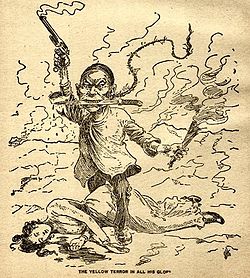
I suspect Howard's statement in 2001 that “We will decide who comes to this country and the circumstances in which they come” tapped into something much more than a fear of extremist forms of Islam.
------------------
No matter how ashamed we might be or should be of the White Australia Policy it has been, for current generations of anglo/celtic/australians, a blessing. As the White Australia Policy was progressively dismantled, we were able to control the numbers – and the fundamental values – of people who have immigrated.
This control, in turn, has given us the luxury of time to wait for each wave of non-Anglos to settle, to change a few things and, without changing us too much, become Australianised.
It is perfectly logical and natural for people of different cultural groups to congregate together when they first move to a new country. Everyone needs to converse in their first language occasionally, simply because they cannot discuss anything complex or important without the words to do so.
Typically, waves of immigrants to Australia
This is no longer happening. We are no longer enjoying a long stretch of over-full employment. We are no longer living in an economy which can benefit from a glut of manual labour. We are no longer living in an economy that can realistically compete in manufacturing, in the long term. Unemployment is a reality for too many Australians and the concept of structural adjustment in industry no longer relevant. Too many workers have good reason to feel insecure about the future.
Increasing the rate of immigration once made sense but that rate is no longer sustainable. Immigrants were once 'useful' not just because they generated growth and provided a bigger and more concentrated internal market, but they made a huge contribution to infrastructure. Because technology and world politics are changing rapidly, immigrants are no longer able to contribute to infrastructure in the same way as they once did but are, instead, adding to the strain on what infrastructure we do have.
As our rate of growth and our prospects for future growth diminish, social support payments are being reeled in to the point where once productive people are suffering. These two forces combined will push us towards negative growth, putting us at risk of depression rather than recession.
Not only can we afford less social supports as the baby boomer generation reaches retirement and contributes less taxes, we have also learned from the experiences of other countries that welfare dependence can be transgenerational and, in the long run, creates a lumpenproletariat and great social instability.
What we are currently seeing is a wave of immigrants who have few prospects of improving their financial position in the future, and little incentive to work at integration.
Their own cultural values combined with their life experiences are such that there is a bigger step required for integration. Integration can no longer be expected within one or two generations. Where once a wave of immigrants settled only temporarily in neighbourhoods for community, we are now seeing waves of immigrants create cultural ghettos for themselves. Where once immigrants required minimal or short term financial support, they are now a long term drain on social support payments, and at risk of creating even more transgenerational welfare dependence.
----------------------------
Increasing or even attempting to maintain the rate of immigration given our current economic circumstances is crazy. We need to balance this craziness against a moral obligation to accept our share of the world’s displaced persons.
Let me go out on a limb here and make some sweeping assumptions on behalf of “my fellow Australians”:
- most Australians are decent and compassionate people who don’t give a rats about somebody’s colour or even religion so long as they are not extremists.
- some people smugglers are simply arranging boats so they can climb on one themselves;
- people don’t risk their lives on leaky boats without a bloody good reason;
- nobody wants to see kids or anyone else drown in incidents like the
Having made those outrages assumptions, I must also insist:
- some people smugglers ARE exploiting human misery for their own gain;
- sometimes the bloody good reason people get on leaky boats does not warrant a reward;
- there may not be queues on every corner of every foreign country, but some people ARE queue jumpers;
And here’s the rub: Our governments are spending ridiculous and disproportionate amounts tapping into our history of xenophobia and promoting asylum seeker hysteria.
We are no longer living in those early formative years of the UN when we first agreed we needed to prevent future wars and make provisions for refugees. We are now often hypocritical when choosing which of our UN obligations will have priority.
Our obligations to refugees are becoming increasingly onerous and complex mainly because our own legislation is becoming increasingly ludicrous. Taking our share of refugees is no longer about providing reasonable levels of food, shelter, security and hope, it is a game in which our governments are happy to set asylum seekers up as a class receiving better support than that available to the average Australian citizen.
The living conditions we provide DO exceed a level of charity nobody should take for granted. The legal rights to appeal go on and on and on and cost an unjustifiable bucket. Every time a policy changes we blow another couple of billion dollars building new facilities in a new location.
In those early years following WWII when we took in displaced persons, or when we promoted sponsored immigration in exchange for labour, people did not have to apply for and wait for refugee status… they already had visas and simply went to temporary centres until they could be usefully placed in the community.
We are now dealing with detention centres, not placement centres.
Let’s be honest and call them prisons.
The lengthy legal and investigative and appeal processes involved in applications for refugee status – designed to improve our treatment of people and show them more respect –are compounding the problem of hopelessness which is eating at these people. It is much the same sense of hopelessness that is eating at indigenous Australia
The living conditions are not the problem, but the no-point-in-hoping-to-start-living conditions.
We do not need to stop the boats because we hate people, and certainly not because we have an ounce of respect for the BS artists who live and work in Canberra
I’ve bored people enough in the past talking about the solutions, but for the purposes of this post I would like to say the following:
We could afford to help a heck of a lot more people, ourselves included, if we stopped the politics and got on with a bit of sensible, efficient planning.
